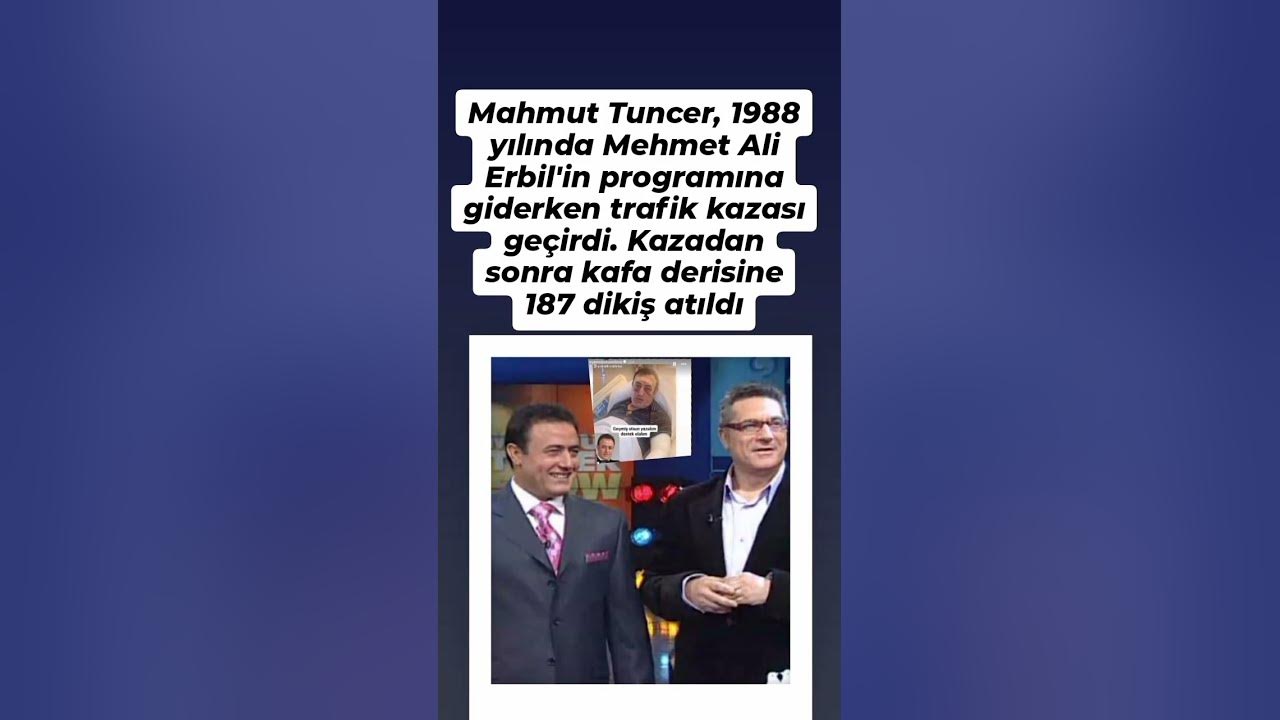
Mahmut Tuncer's 1988 Horror: 187 Stitches and Stitched Alive
The world of entertainment often shields its stars from the darker realities of life, presenting a facade of glamour and ease. However, for Turkish music icon Mahmut Tuncer, one terrifying event in 1988 shattered that illusion, leaving him with an unforgettable ordeal and a harrowing story of survival. This wasn't just any incident; it was a devastating **Mahmut Tuncer kaza** (accident) that left the beloved artist with an astonishing 187 stitches on his face and the chilling memory of being "stitched alive." This profound experience, recently recounted by Tuncer himself, serves as a stark reminder of life's fragility and the incredible resilience of the human spirit.
A Fateful Journey: The 1988 Mahmut Tuncer Accident
The year was 1988. Mahmut Tuncer, then a rising star, was en route to an engagement following a flight. He had just landed after traveling for a program featuring Mehmet Ali Erbil in Ankara. As is often the case in the entertainment industry, schedules are tight, and travel is constant. However, what should have been a routine journey by car quickly turned into a nightmare. As their vehicle navigated the Çubuk Kavşağı (Çubuk Junction), tragedy struck. Their car was involved in a severe collision.
The impact was catastrophic. Mahmut Tuncer vividly recalls being violently ejected from the vehicle, a staggering distance of nine meters. "I was thrown 9 meters outside," he recounted in an interview. The immediate aftermath was a blur, a chaotic scene of metal, glass, and confusion. When he regained consciousness, he found himself sitting in a cross-legged position, surrounded by a horrifying sight: "The place was a pool of blood." In a state of shock and perhaps disbelief, Tuncer initially thought his injuries were minor, merely a "small scratch" on his face. This initial misperception highlights the brain's defense mechanism in the face of extreme trauma, attempting to minimize the horror.
Upon arrival at the hospital, the gravity of his situation became terrifyingly clear. The reactions of those around him were telling. "People who saw me came over saying, 'What a pity for him,'" Tuncer recalled. Still experiencing little pain due to the shock and adrenaline, he couldn't comprehend the full extent of the damage. When he asked to see his face, the medical staff gently but firmly advised him against it. Their reluctance only heightened his anxiety, building a dreadful suspense for what he was about to witness. The moment he finally caught a glimpse of his reflection, it was like something from a horror film.
The Unfathomable Reality: 187 Stitches, Stitched Alive
The sight was utterly gruesome. Mahmut Tuncer's description painted a vivid and horrifying picture: "My scalp was lifted, and my neck was hanging down." Beyond these severe injuries, his nose and eyebrow also suffered significant tears, contributing to the extensive damage. The incident was a testament to the raw, unadulterated power of a traffic accident and its potential to disfigure and devastate.
What followed was perhaps the most excruciating part of his ordeal: the extensive repair work. Due to the severe head trauma he sustained, general anesthesia was deemed too risky. This meant that the delicate and intricate process of closing his wounds, involving an incredible 187 stitches, had to be performed with him conscious, experiencing every single sensation. "Because I received a blow to the head, they stitched 187 stitches while I was alive," he revealed, his voice still carrying the weight of that memory. "I felt every needle that went in."
Imagine the sheer agony, the mental fortitude required to endure such a procedure. Each prick, each tug, each stitch was a testament to the surgeons' skill and Tuncer's incredible resilience. This wasn't merely a medical procedure; it was an act of survival, a test of endurance unlike any other. The number of stitches, 187, speaks volumes about the complexity and severity of the facial and scalp lacerations. Tuncer credits the surgeons with remarkable skill, noting that despite the extensive work, there are no visible signs of aesthetic procedures on his face today. He mused that perhaps the high stitch count was partly due to an aesthetic approach, ensuring the best possible outcome for a public figure. "Maybe it would have ended in 100 stitches, but they did 187 stitches for aesthetics," he commented, expressing profound gratitude for their meticulous work.
This horrifying experience underscores the profound impact an accident can have, not just physically, but psychologically. The memories of such a traumatic event can linger for decades, shaping one's perspective on life, vulnerability, and the preciousness of each moment.
Beyond the Physical Scars: Psychological Impact and Recovery
The immediate aftermath of the **Mahmut Tuncer kaza** meant a significant period of withdrawal from public life. Healing from such extensive physical wounds, especially on the face, is a long and arduous process. Beyond the physical recovery, the psychological toll of such a near-fatal and disfiguring experience cannot be overstated. "I had to stay away from everything for a long time," Tuncer shared, indicating the necessary isolation required for both physical recuperation and mental healing.
Recovering from severe trauma often involves grappling with fear, anxiety, and even post-traumatic stress. For a public figure, the added pressure of appearance and the spotlight can make this journey even more challenging. Tuncer’s ability to not only recover but to continue his successful career is a testament to his indomitable spirit and determination. His story highlights the profound capacity of humans to adapt, heal, and find strength in the face of adversity. Support systems, both professional and personal, play a crucial role in navigating such a recovery, helping individuals to process the trauma and rebuild their lives. His candid sharing of this painful chapter decades later also serves as a powerful message about facing one's past and acknowledging the journey of healing.
Distinguishing Fact from Fiction: Mahmut Tuncer's Past Trauma vs. Recent Rumors
It's crucial to distinguish this historical, deeply traumatic event from recent, unfounded rumors. In a separate development, there were false reports circulating on social media regarding a *new* traffic accident involving Mahmut Tuncer. These recent claims, often accompanied by misleading images, suggested that the artist had again been injured and was receiving hospital treatment.
However, these rumors were quickly and definitively debunked by Tuncer’s lawyer, Fırat Çetintaş. In an official statement, Çetintaş clarified that these social media posts were entirely baseless and that Mahmut Tuncer was in excellent health. He emphasized the importance of relying solely on official sources for accurate information and warned that legal action would be taken against those spreading misinformation.
It's important for the public to understand the clear distinction: the 1988 accident was a real and devastating event that profoundly impacted Tuncer’s life. The recent reports, on the other hand, were mere fabrications. For a more detailed look at the debunking of these recent claims, you can read
Mahmut Tuncer Accident Rumors Debunked: Lawyer Speaks Out. To further understand the contrast between his past trauma and the recent misinformation, explore
Mahmut Tuncer: Past Accident Trauma vs. Current Rumor Clarification. In an age of rapid digital information, verifying facts and understanding the context of news is more vital than ever, particularly when it concerns the well-being of public figures.
Lessons Learned: Road Safety and Resilience
Mahmut Tuncer's harrowing **Mahmut Tuncer kaza** in 1988 serves as a powerful and enduring cautionary tale about the unpredictable dangers of road travel. While he didn't explicitly detail the circumstances of his being thrown from the car, the incident underscores the critical importance of road safety measures. Simple actions, like wearing a seatbelt, can dramatically alter the outcome of an accident, preventing severe injury or even fatality. Defensive driving, adhering to speed limits, and avoiding distractions are not just rules but life-saving habits that every driver and passenger should prioritize.
Beyond the practical lessons of road safety, Tuncer's journey is a profound testament to human resilience. To endure such extreme physical trauma, the agony of being "stitched alive," and the long road to recovery, yet emerge to continue a thriving career, speaks volumes about his inner strength. His story is an inspiration, demonstrating that even after facing life-altering events, it is possible to heal, adapt, and continue living a fulfilling life. It's a reminder that while accidents can leave indelible physical and emotional scars, they do not have to define one's entire future.
Conclusion
Mahmut Tuncer's 1988 accident, a truly horrific **Mahmut Tuncer kaza**, remains a defining, albeit painful, chapter in his life story. The sheer brutality of the event, leaving him with 187 stitches and the conscious experience of being stitched alive, offers a stark glimpse into the unpredictable nature of life. His courage in recounting this ordeal, decades later, not only sheds light on the personal cost of such an incident but also celebrates the remarkable skill of his surgeons and his own incredible resilience. This story serves as a powerful reminder of the importance of road safety, the incredible capacity of the human body and spirit to heal, and the critical need for accurate information in an often sensationalized world. Tuncer's ability to overcome such a devastating trauma and continue his successful career stands as a testament to his strength and enduring spirit.